Coaching vs Mentoring vs Consulting: What’s the difference?
Coaching, mentoring and consulting are often confused for the same thing; they’re not.
If you’re leading a business, part of a leadership team, or thinking about bringing in external support, you’ve probably come across all three. Each offers something different. And choosing the wrong one, or expecting one to do the job of another, is one of the most common reasons people feel underwhelmed by the support they invest in.
This guide is designed to make that distinction clearer, so you can decide what will be most useful for your situation.
Why this distinction matters
In many cases, the issue is not that an organisation chose the wrong provider. More often, the problem is that the type of support didn’t match the challenge they were trying to solve.
If what you need is specialist expertise and a clear recommendation, coaching may feel too open-ended.
If what you really need is behavioural change, stronger leadership or better decision-making, a consultant may produce a sound piece of work that still doesn’t fully land.
If what you need is guidance from someone who understands the path you’re on, but you instead choose a coach, you may miss the value of lived perspective and context.
The clearer you are about what kind of support you need, the more likely you are to get proper value from it.
What is coaching?
Coaching is a structured, professionally led process that helps individuals or teams think more clearly, build confidence and strengthen capability. A coach is not there to tell you what to do. Their role is to help you reflect, challenge assumptions, surface what you already know and support you to arrive at better decisions.
The underlying idea is that the person being coached often already has much of what they need, whether that is judgement, instinct, experience or potential. What is often missing is the time, space and skilled challenge needed to think properly. A good coach creates those conditions.
Coaching is most often one-to-one, but it can also happen at team level. Team coaching is particularly helpful when the issue is not just individual capability, but how a leadership team works together as a group. Read more about the benefits of team coaching here >
Coaching works well when:
A leader is stepping into a more senior or more complex role
A founder or CEO needs space to think and a trusted, independent challenge
A manager is strong technically but finds the people side of leadership harder
A leadership team has good conversations but struggles to make decisions or follow through
Someone is navigating a significant change in their role, business or life
A leader wants to strengthen areas such as strategic thinking, confidence, emotional intelligence, presence or handling conflict
Coaching is less helpful when:
You need a clear expert recommendation
You need someone to diagnose a technical problem and produce a solution
You are expecting direct advice about what decision to make
If you need answers or specialist expertise, coaching on its own is unlikely to be enough.
What is mentoring?
Mentoring is a developmental relationship in which someone with relevant experience, perspective or organisational knowledge supports another person’s growth.
A mentor will often share what they have learned, offer guidance, ask questions and help the other person think through challenges. Unlike coaching, mentoring usually draws more directly on the mentor’s own experience. But good mentoring is not simply someone “telling you what to do”. At its best, it is a thoughtful conversation that helps someone grow in confidence, judgement and understanding over time.
Mentoring is often less formal than coaching and tends to develop over a longer period. It can be especially useful when someone is stepping into a new role, navigating a particular organisational context, or wanting to learn from someone who has faced similar situations before.
Mentoring works well when:
Someone is moving into a more senior role and would benefit from perspective
A leader wants guidance from someone who understands the sector, organisation or context
Long-term career development is the focus
Someone would benefit from encouragement, support and insight from a trusted senior figure
Mentoring is less helpful when:
You need behavioural change
You need a strong, independent challenge rather than guidance
Your situation is genuinely new or complex in a way that goes beyond someone else’s experience
A mentor’s perspective can be hugely valuable, but it is still shaped by their own experience. That can be helpful, though it may not always open up the same kind of thinking space that coaching does.
What is consulting?
Consulting is expertise-led. A consultant brings specialist knowledge, helps analyse a situation and makes recommendations or delivers something specific on your behalf. The value sits in what they know, how they diagnose the issue and what they produce.
Consultants are usually brought in for defined pieces of work such as a strategic review, market analysis, organisational redesign, change programme or another problem where the organisation wants a clear piece of external thinking or a concrete output. The relationship is often project-based and time-limited, and it usually ends with a deliverable.
Consulting works well when:
You need specialist expertise that does not exist internally
The problem is fairly well defined, and you need analysis, recommendations or a plan
Speed and technical knowledge matter more than capability-building
You want an independent view to challenge internal assumptions or politics
Consulting is less helpful when:
The main challenge is behavioural or relational
The issue is really about leadership, team dynamics or culture
You need people to think and act differently, not just understand the issue
Consulting can produce excellent insight. But if the real challenge is how people lead, communicate or work together, recommendations alone often struggle to create lasting change.
What is facilitation?
Facilitation is slightly different. A facilitator is not there to impose an answer in the way a consultant might be. But they are also not coaching in the pure sense. A good facilitator brings structure, process, challenge and an external perspective to help a group think well together.
Their job is to design and guide the conversation so the team can explore the right issues, surface assumptions, have more honest discussions and arrive at clear decisions. The answers still come from the group. The facilitator helps the group get there. This is often particularly valuable when a leadership team needs to align around strategy, culture, priorities or ways of working.
A practical way to think about the difference
One way to understand the distinction is to look at where the value comes from in each relationship.
With consulting, you are drawing on expertise. The consultant’s value lies in their knowledge, diagnosis and recommendations.
With mentoring, you are learning from someone’s perspective and experience. The mentor helps by sharing what they have seen, done and learned.
With coaching, the value sits more with you. The coach’s role is to help you think more clearly, challenge your assumptions and strengthen your own judgement so that you can make better decisions and lead more effectively over time.
None of these approaches is better than the others. They are simply designed for different purposes.
In practice, the boundaries can blur. Some mentors use coaching-style questions, and some coaches may occasionally share their perspective. The difference usually lies in the primary purpose of the relationship.
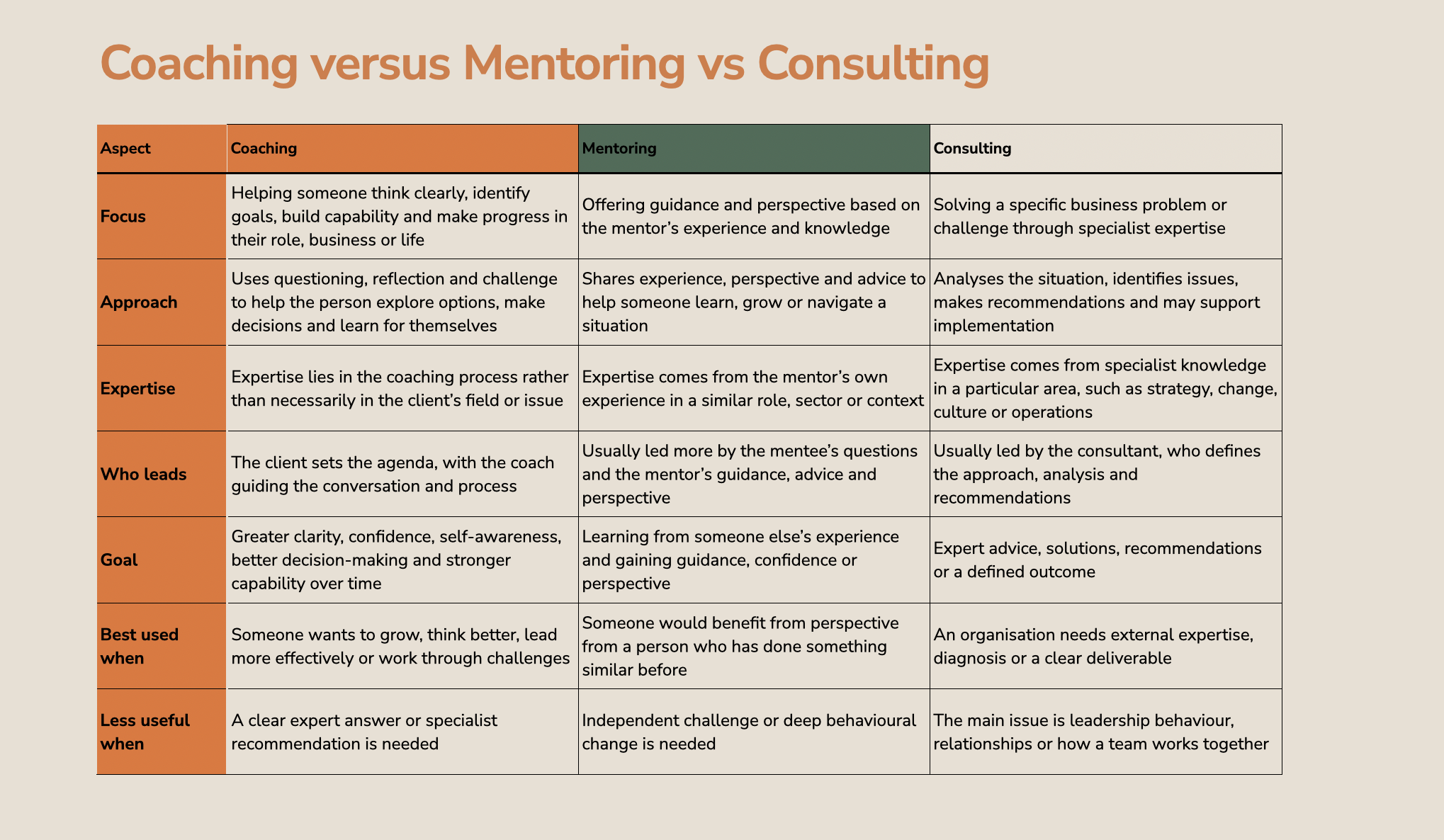
Coaching versus Mentoring versus Consulting: What’s the difference
How to decide what you need
A simple way to think about it is this:
If you need specialist expertise or a clear recommendation, consulting is usually the right fit.
If you would benefit from guidance from someone who has faced similar challenges, mentoring may help.
If you need space to think, stronger judgement or lasting behavioural change, coaching is often the better choice.
Can you combine coaching, mentoring and consulting?
Yes, and often the most effective support does exactly that. For example, a leadership team might work with a facilitator to agree strategic direction while individual leaders receive coaching to help them lead the change well. A senior leader might benefit from a mentor with strong sector experience alongside a coach who can challenge their thinking more deeply and help them shift behaviour. An organisation might bring in a consultant for analysis, then use coaching or facilitation to help leaders turn that insight into action.
What matters is being clear about what each type of support is for, and not expecting one to do the work of another.
Why choosing the right kind of support matters
On the surface, coaching, mentoring and consulting can look similar. All three involve conversations, external support and some form of development.
But they work in very different ways and are useful for different reasons. That’s why it matters to get clear about the kind of support that will genuinely help. Do you need expertise? Perspective? Independent challenge? Space to think? A clearer plan? Stronger capability?
The clearer you are about the challenge in front of you, the easier it becomes to choose support that is genuinely useful rather than simply sounding right on paper.
How Growth Space can help
At Growth Space, we support founders, senior leaders and leadership teams through:
If you’re working out what kind of support would be most useful, I’d be very happy to chat.
Get in touch with Polly on 07966 475195 or email polly@growth-space.co.uk
.