Leadership Trends for 2026
What shifts in leadership will we see in 2026?
It’s tempting to look for the next big idea or a new leadership model that explains everything. If you talk to leaders across different sectors, the same themes keep showing up. It’s not that one dramatic change has arrived overnight; it’s that the way we lead hasn’t quite kept pace with the world we’re working in. Teams are more diverse, dispersed and stretched. Expectations from employees and customers are higher. And organisations are recognising that the leadership approaches that worked five or ten years ago simply won’t carry them forward in 2026.
Leaders who pay attention to these shifts now will create organisations that feel clearer, healthier and more resilient. They’ll retain their best people, navigate uncertainty and build teams that can genuinely thrive. Those who continue to lead as if nothing has changed will feel the strain more quickly.
Here are the key shifts I think matter most for leaders and people & culture heads in 2026:
Leaders will need to stay outward-looking, talk honestly about what’s changing and adapt plans quickly while supporting people through uncertainty.
Hybrid and remote work will be less about location and more about how teams collaborate, communicate and stay connected.
Psychological safety, emotional intelligence and well-being will become essential to performance, not add-ons.
Cross-functional working and shared ownership will be crucial for delivering strategy in complex environments.
AI will support leaders, but human judgement, ethical awareness and communication will grow in importance.
Learning, development and feedback will move towards regular, simple, behaviour-focused approaches.
Sustainable working rhythms will matter: fewer meetings, more thinking time and better prioritisation
1. Uncertainty will continue, and leaders must plan, adapt and communicate openly
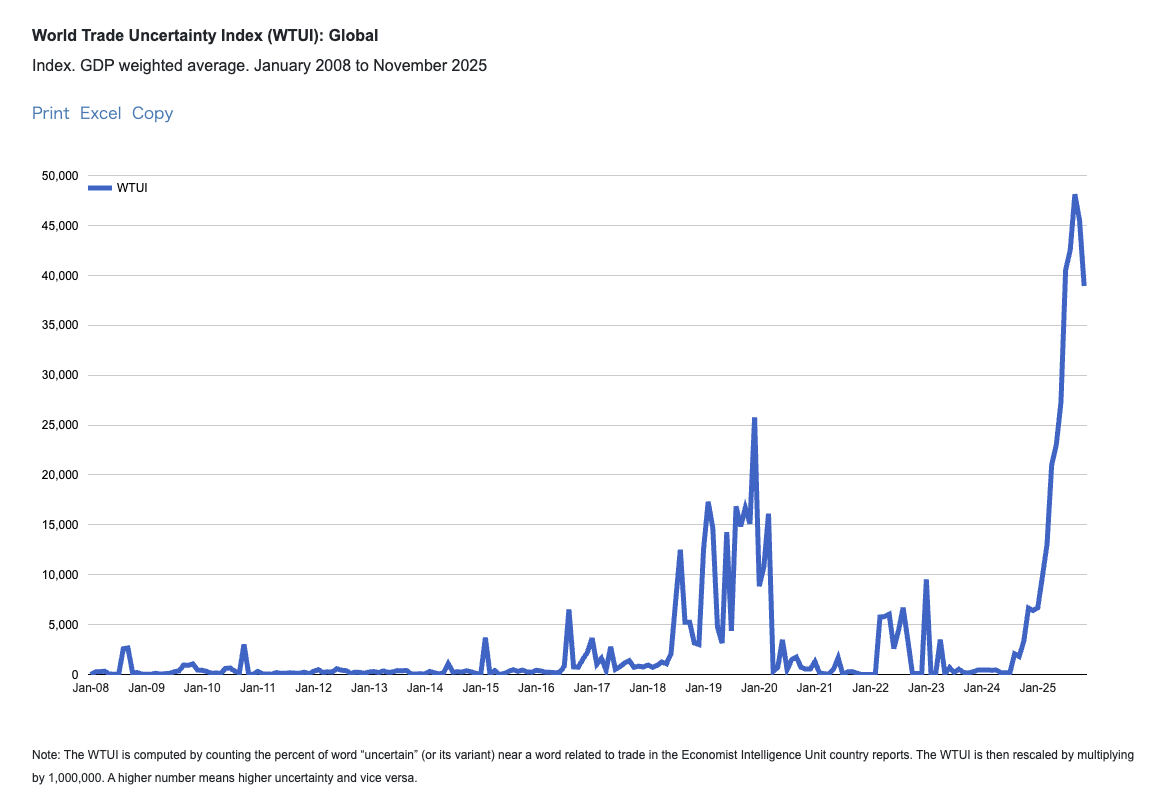
World Trade Uncertainty Index 2025
The uncertainty of 2025 isn’t going to disappear. Economic, geopolitical and environmental shifts will continue. Long-term plans are more vulnerable in this context, and rigid strategic cycles will create more frustration than progress. This doesn’t mean abandoning planning altogether - it means planning differently.
Leaders need to look outward, notice what’s changing, and adjust their approach without waiting for perfect information. They don’t need to have all the answers, but they need to be able to adapt and communicate openly about what’s shifting and why. People don’t expect certainty; they expect honesty, steadiness and support.
What this means for leaders:
Plan in shorter cycles and review plans more frequently
Bring people into the conversation early, even when answers aren’t final
Share what you know, what you don’t know, and what you’re watching
Use scenario planning rather than fixed long-term assumptions
Support the team emotionally when things feel volatile
Questions to reflect on:
How comfortable am I communicating when things are uncertain?
Do I help people understand what’s changing around us or shield them from it?
What decisions am I postponing because I’m waiting for perfect information?
How quickly do we adapt direction when the context changes?
2. Hybrid and remote work continue to evolve, and the focus shifts to how teams work together
Hybrid and remote working are here to stay, but we’re still learning how to do them well, and teams continue to experiment, adjust routines and refine expectation. Research shows no single model produces higher engagement or lower burnout; what matters is how teams coordinate, connect and communicate. The real leadership challenge is designing how the team works, not deciding where it works.
What this means in practice:
Expect to keep adjusting ways of working as teams evolve
Make in-person time purposeful - relationship-building, problem-solving, creativity
Reduce unnecessary meetings and protect time for deep work
Establish clear agreements on availability, responsiveness, and decision-making
Build rhythms and rituals that replace the informal connection the office once provided
Questions to reflect on:
Do we have shared expectations about communication and availability, or are people guessing?
When we meet in person, is the time used well?
What gets in the way of effective collaboration when we’re not in the same place?
Where do we need more structure, and where do we need less?
3. Psychological safety, emotional intelligence and well-being are essential to performance
Teams work better when they feel safe to speak up, disagree, admit mistakes and ask for help. In dispersed teams, especially, this psychological safety becomes the glue that holds performance together.
Emotional intelligence becomes a core leadership skill: reading the room, responding rather than reacting, holding difficult conversations, navigating conflict and supporting wellbeing in meaningful ways.

What this means for leaders:
Respond calmly and constructively when problems surface
Address tension early rather than letting it build
Be clear rather than vague — uncertainty grows in silence
Talk openly about workload, capacity and wellbeing
Model the honesty you want from others
Questions to reflect on:
How do people feel after speaking to me about a problem?
Do issues surface early in my team, or only when they’re urgent?
Which of my own reactions or habits might be impacting psychological safety?
Where do I need to strengthen my emotional intelligence?
4. Cross-functional alignment is critical to delivering strategy
Organisations are dealing with more interdependent work, faster cycles, and more complex customer needs. No single team can deliver on strategy alone. The biggest performance gaps in organisations are increasingly between teams, not within them.
This is where team coaching, rather than individual coaching, is becoming essential. Many teams are full of capable individuals who struggle to perform collectively. Strategy gets stuck not because people lack skill, but because alignment, trust and shared ownership are missing.
What this means for leaders:
Create shared goals and clear priorities across functions
Clarify roles, decision rights and who owns what
Remove blockers quickly and visibly
Surface tensions, rather than working around them
Invest in team coaching, not just individual coaching
Questions to reflect on:
If I asked my leadership team to explain our priorities, would they give the same answer?
Where does work get stuck between teams?
What conversations are we avoiding because they feel uncomfortable?
What support do our teams need to collaborate more effectively?
5. AI supports leaders - but human judgement matters more than ever
AI will become increasingly embedded in leadership tasks: helping analyse data, draft communications, identify risks and plan scenarios. But AI cannot replace human skills - judgement, ethics, trust-building or the ability to guide people through uncertainty.
As AI takes on more technical tasks, the most valuable leadership skills will be distinctly human: curiosity, empathy, ethical reasoning, relationship-building, and decision-making.
What this means in practice:
Use AI to save time, but stay accountable for interpretation
Be transparent about how decisions are made when AI is involved
Strengthen communication, people need context, not just output
Ensure teams have fair access to tools and training
Develop your own confidence in using AI without becoming dependent on it
Questions to reflect on:
Where could AI genuinely help me make better decisions?
Where should we avoid using AI because the human relationship matters more?
How prepared is my team to use AI effectively and safely?
Which leadership skills do I need to strengthen as AI becomes more common?
6. Learning, development and feedback shift to small, practical behaviour changes
People don’t want complex leadership models or lengthy programmes that sit outside their day-to-day reality. They want simple tools, practical support and honest feedback delivered regularly. Organisations are moving towards shorter learning cycles, coaching-style conversations and development tied directly to work
What this means in practice:
Give feedback early and often, not once or twice a year
Use small behaviour changes rather than overwhelming people with theory
Build learning into real work through reflection and experimentation
Make development practical: simple scripts, clearer expectations, real examples
Support your managers to have better conversations, not just attend training
Questions to reflect on:
When did I last give someone timely, specific, supportive feedback?
Do we expect managers to develop people without giving them the tools?
What small behaviour shifts would make the biggest difference to performance?
How can I make development feel more relevant and less overwhelming?
7. Sustainable performance matters: fewer meetings, more thinking time
With the organisations I work with, everyone says the same thing - we spend too much time in meetings, and not enough time doing the work or creating space for deep thinking and innovation.
Too many meetings and reactive communication leave little space for strategic thinking, reflection or meaningful progress. Leaders will need to protect thinking time, their own and their team’s, and redesign working rhythms so people have space to do good work.
What this means for leaders:
Protect thinking time for yourself and your team
Cut meetings that could be asynchronous and try cutting regular meetings by 15 minutes to create more focus.
Tackle decision bottlenecks that slow people down
Clarify priorities so the team can focus on what truly matters
Build working rhythms that support sustainable momentum
Questions to reflect on:
How much time do I protect for deep work, and how often do I break that boundary?
What meetings would we stop tomorrow if we were brave enough?
Where does noise or distraction creep into the team’s workflow?
How can we create more space for better thinking?
How these trends fit together
These shifts stand alone. They reinforce one another:
Emotional intelligence strengthens communication during uncertain times
Hybrid working requires a stronger culture, clearer expectations and psychological safety
AI amplifies the importance of human judgement and people-first leadership skills
Cross-functional execution becomes easier when psychological safety and trust are strong
Sustainable working rhythms support better decisions, clearer thinking and healthier teams
Leadership is becoming less about control and more about creating the conditions for people to do their best work — with adaptability, openness and shared ownership.
It’s worth asking:
Where are we leading in ways that no longer fit how the organisation works today?
What do our people need from us right now to feel steady, capable and supported?
Which one or two shifts would make the biggest difference to performance and wellbeing?
If you’d like support with your leadership, teams, strategy or culture, let’s talk.
We can help to:
Bring your leadership team together to align on direction, priorities and how you’ll work together
Translate business goals into practical actions and working rhythms
Create a culture where people feel they belong, stay connected and perform at their best
Strengthen leadership capability through one-to-one coaching and leadership development programmes
Build high-performing teams and improve team effectiveness through workshops and team coaching
To find out how I can support you, get in touch: polly@growth-space.co.uk or 07966 475195.